
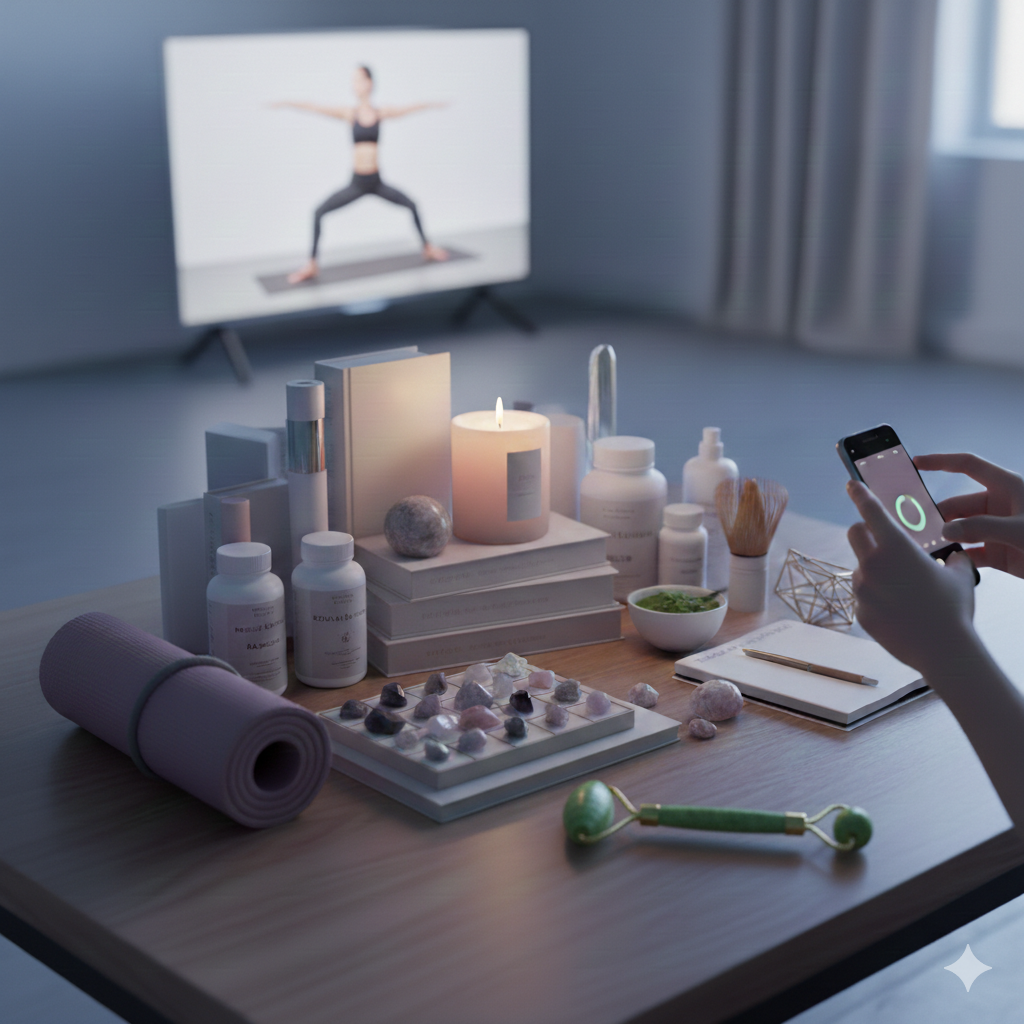
You’ve got the morning routine down. Meditation app open at 6 AM. Green smoothie in hand. Gratitude journal filled with three things you’re thankful for, written in aesthetically pleasing handwriting. Your skincare has twelve steps. Your supplements are organised by colour. Your yoga mat is always unrolled, waiting. You’re doing all the self-care things. So why do you feel so exhausted?
Because self-care has become another performance, another metric, another way to feel like you’re not quite doing enough. It’s saltwater dressed up as wellness.
When Caring for Yourself Becomes a Chore
Self-care was supposed to be the antidote to burnout. A radical act of preservation in a world that wants to extract every ounce of energy from us. But somewhere along the way, it morphed into something else entirely. It became an industry. A brand. An Instagram aesthetic. A new form of perfectionism.
Now self-care looks like purchasing the right products, following the right routines, achieving the right level of zen. It’s face masks and bath bombs and £40 candles. It’s bullet journals and wellness retreats and adaptogens you can’t pronounce. It’s performing wellness so well that others can see how well you’re taking care of yourself.
This isn’t care. This is consumption. And like all forms of consumption sold as solutions, it leaves us thirstier than before.
The Wellness-Industrial Complex
The global wellness industry is worth over £4 trillion. Think about that for a moment. Feeling stressed, burnt out, depleted? Don’t worry—there’s a product for that. A course. A certification. A subscription box full of self-care essentials you didn’t know you needed until an algorithm told you so.
The irony is devastating. We’re so exhausted from trying to keep up with modern life that we need self-care. But the self-care we’re sold requires more time, more money, more energy, more mental load to maintain. It becomes yet another thing on the to-do list, another area where we can fail, another source of guilt when we don’t measure up.
Did you meditate today? Did you move your body joyfully? Did you drink enough water, get enough sleep, set enough boundaries, practice enough gratitude? Did you do your self-care properly?
The Performance of Feeling Better
Here’s what makes performative wellness so insidious: it mimics genuine self-care so closely that it’s hard to tell the difference. Both involve taking time for yourself. Both might include similar activities. But one nourishes you, and the other just makes you feel guilty for not doing it right.
Performative self-care is doing something because it looks like wellness. Real self-care is doing something because it actually helps you feel better, even if it doesn’t photograph well.
Performative self-care follows someone else’s routine because it worked for them. Real self-care means figuring out what actually works for your nervous system, your schedule, your life—even if it’s unconventional.
Performative self-care feels like an obligation. Real self-care feels like coming home to yourself.
Signs Your Self-Care Has Become Saltwater
How do you know if wellness has become another performance? Watch for these patterns:
- You feel guilty when you skip your self-care routine
- You’re doing self-care activities you don’t actually enjoy because you think you should
- You’re spending money you don’t have on wellness products
- You photograph or track your self-care more than you experience it
- Your self-care routine takes so much time and energy that it’s become stressful
- You feel like you’re failing at wellness
- You’re following someone else’s definition of self-care rather than your own
- You compare your self-care to others’ and feel inadequate
The Privilege Paradox
We need to talk about the elephant in the wellness room: privilege. Much of what’s sold as essential self-care requires resources many people simply don’t have. Time. Money. Energy. A quiet space. The ability to take a mental health day without losing your job.
When self-care becomes aspirational rather than accessible, it stops being care and starts being another way to feel behind. Another way to internalise the message that if you’re struggling, it’s because you’re not trying hard enough, not investing enough, not doing enough wellness.
But genuine self-care doesn’t require a credit card. It doesn’t need to be documented or beautiful or aligned with someone else’s aesthetic. It just needs to actually help you feel more human.
“Self-care is not self-indulgence, it is self-preservation.” —Audre Lorde
What Real Self-Care Actually Looks Like
Real self-care might be boring. It might be unsexy. It might not make good content.
It’s going to bed at a reasonable hour even though you’d rather scroll. It’s saying no to plans when you’re genuinely exhausted, not because you’re doing a digital detox challenge. It’s crying when you need to cry. It’s asking for help. It’s letting the dishes sit overnight because you genuinely don’t have it in you.
It’s eating food that nourishes you, whether or not it’s organic or locally sourced or posted on your Instagram story. It’s moving your body in ways that feel good, not in ways that burn the most calories. It’s doing absolutely nothing without calling it rest or recovery or self-care—just doing nothing because sometimes that’s what you need.
Real self-care is listening to yourself rather than performing for others. It’s the still in the stillness, not the performance of being still.
The Distillation Process
So how do you separate genuine self-care from the saltwater of performative wellness? Ask yourself these questions:
Does this actually make me feel better, or does it just look like it should? Am I doing this for myself or for the performance of wellness? Does this nourish me or does it just give me something to feel guilty about?
The answers won’t always be clear. Sometimes you genuinely love your elaborate skincare routine. Sometimes you really do find peace in your morning meditation. That’s fine. The question isn’t whether these activities are inherently good or bad—it’s whether they’re serving you or whether you’re serving them.
True self-care requires no audience. It asks for no applause. It doesn’t need to be optimised or aesthetically pleasing or Instagrammable. It just needs to help you feel a bit more like yourself, a bit more capable of facing whatever comes next.
That’s the distillation. That’s the still. And you can’t perform your way there.
Leave a Reply