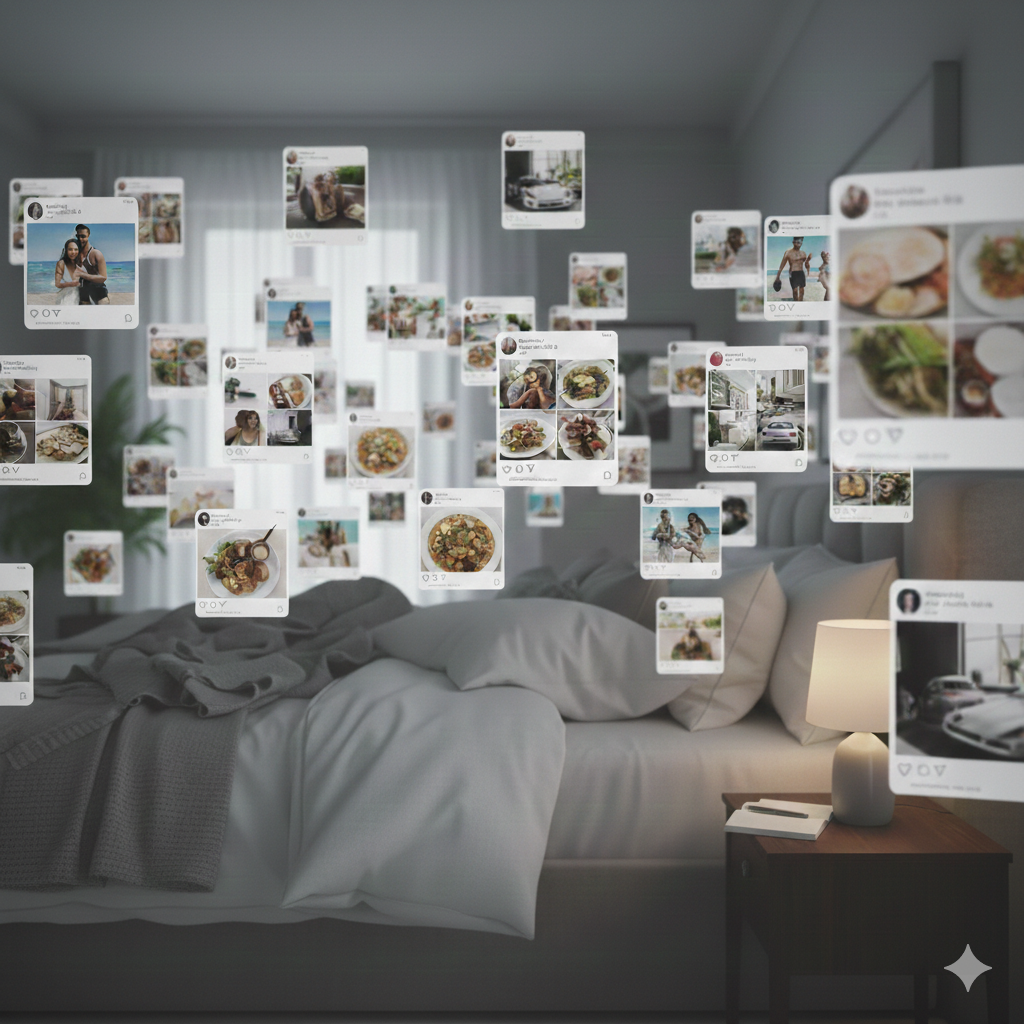
You open Instagram feeling fine. Maybe even good. Ten minutes later, you close the app feeling vaguely inadequate, restless, like you’re somehow behind in a race you didn’t know you were running. Your life, which felt perfectly acceptable moments ago, now seems smaller. Duller. Not quite enough.
Welcome to the comparison trap—one of the purest forms of saltwater our modern world offers.
The Thirst That Grows With Every Sip
Here’s what makes social media comparison so insidious: it disguises itself as connection, inspiration, even motivation. We tell ourselves we’re just staying in touch, gathering ideas, supporting our friends. And sometimes that’s true. But scroll long enough, and something shifts.
Someone’s vacation looks more adventurous than yours. Someone’s career move looks braver. Someone’s body looks better, their relationship looks easier, their kids look happier, their home looks more beautiful. And suddenly, you’re not just observing their life—you’re measuring your own against it.
This is saltwater. The more you drink, the thirstier you become.
Why Comparison Leaves Us Parched
Social media comparison doesn’t just make us feel bad—it creates a specific kind of emptiness that’s almost impossible to fill. Here’s why:
We’re comparing our behind-the-scenes to everyone else’s highlight reel. You know the messy reality of your own life—the arguments, the doubts, the days you don’t shower. But you’re comparing that intimate knowledge to carefully curated glimpses of others’ best moments. It’s not a fair fight.
The goal posts keep moving. Even when you achieve something you’ve been comparing yourself over—a promotion, a fitness milestone, a beautiful home—there’s always someone further ahead. The comparison never ends because there’s always more to want.
It disconnects us from our own desires. When we’re constantly looking at what others have, we lose touch with what we actually want. Do you really want that aesthetic kitchen, or have you just seen it 47 times this week? Is that career path truly calling to you, or does it just look good on LinkedIn?
The Psychology Behind the Scroll
Our brains weren’t designed for this. For most of human history, we compared ourselves to maybe 50-150 people in our immediate community. Now we’re comparing ourselves to thousands—carefully filtered, professionally photographed, algorithmically selected to be the most engaging (read: envy-inducing) content possible.
Research shows that social media comparison is linked to increased anxiety, depression, and lower self-esteem. One study found that limiting social media use to 30 minutes per day led to significant reductions in loneliness and depression. The saltwater metaphor isn’t just poetic—it’s physiological.
Signs You’re Drinking the Saltwater
How do you know if social media comparison has become a problem? Watch for these signals:
- You feel worse about your life after scrolling than before
- You catch yourself thinking “I should be further along by now”
- You feel a twinge of disappointment (or worse, satisfaction) at others’ failures
- You’re making decisions based on how they’ll look online rather than how they’ll feel in real life
- You can’t enjoy your own moments without photographing them
- You’re spending more time documenting your life than living it
What To Do Instead
Recognizing the saltwater is the first step. You don’t have to quit social media entirely (though some people find that helpful). But you do need to become conscious of when you’re drinking something that makes you thirstier.
Try this: Before you open an app, pause. Ask yourself what you’re actually looking for. Connection? Inspiration? Distraction from discomfort? Then, after you scroll, check in again. Did you get what you were seeking, or do you feel emptier than before?
The answer will tell you everything you need to know.
“Comparison is the thief of joy.” —Theodore Roosevelt
The paradox is this: the antidote to comparison isn’t thinking more highly of yourself. It’s thinking of yourself less. It’s getting so absorbed in your own life—your own growth, your own relationships, your own purpose—that you don’t have time to measure yourself against strangers on the internet.
That’s the still. That’s the distillation. And it starts with recognizing the saltwater for what it is.
Leave a Reply